Mesh API を使用して放射状の進捗インジケーターを作成
バージョン:2023.2 以降
この例では、Mesh API を使用してビジュアル要素にビジュアルコンテンツを描画する方法を示します。
ノート: Mesh API は上級者向けのツールです。バージョン 2022.1 以降では、単純なジオメトリのみを生成する場合は、代わりに Vector API を使用してください。詳細は、Vector API を使用して放射状の進捗インジケーターを作成を参照してください。
例の概要
この例では、 プログレスバーの代わりに進行状況を表示するカスタムコントロールを作成します。進捗インジケーターは、パーセントを表示するラベルの周囲に、部分的に塗りつぶされた輪で進捗値を表示します。0 から 100 の間の値で表示され、その値に対応して輪がどの程度塗りつぶされるかが決定されます。
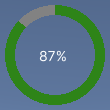
この例で作成して完成したファイルは、この GitHub リポジトリにあります。
必要な要件
このガイドは、Unity エディター、UI Toolkit、および C# スクリプトに精通している開発者を対象としています。始める前に、以下の点を理解しておいてください。
放射状の進捗インジケーターとそのカスタムメッシュの作成
C# スクリプトを作成して RadialProgress クラスを定義し、UXML と UI Builder にコントロールを公開します。
- 任意のテンプレートで Unity プロジェクトを作成します。
- ファイルを保存する
radial-progressという名前のフォルダーを作成します。 -
radial-progressフォルダーに、以下のコンテンツを含むRadialProgress.csという C# スクリプトを作成します。
using Unity.Collections;
using UnityEngine;
using UnityEngine.UIElements;

namespace MyUILibrary
{
    /// <summary>
    /// An element that displays progress inside a partially filled circle
    /// </summary>
    [UxmlElement]
    public partial class RadialProgress : VisualElement
    {
        // These are USS class names for the control overall and the label.
        public static readonly string ussClassName = "radial-progress";
        public static readonly string ussLabelClassName = "radial-progress__label";

        // These objects allow C# code to access custom USS properties.
        static CustomStyleProperty<Color> s_TrackColor = new CustomStyleProperty<Color>("--track-color");
        static CustomStyleProperty<Color> s_ProgressColor = new CustomStyleProperty<Color>("--progress-color");

        // These are the meshes this control uses.
        EllipseMesh m_TrackMesh;
        EllipseMesh m_ProgressMesh;

        // This is the label that displays the percentage.
        Label m_Label;

        // This is the number of outer vertices to generate the circle.
        const int k_NumSteps = 200;

        // This is the number that the Label displays as a percentage.
        float m_Progress;

        /// <summary>
        /// A value between 0 and 100
        /// </summary>
        [UxmlAttribute]
        public float progress
        {
            // The progress property is exposed in C#.
            get => m_Progress;
            set
            {
                // Whenever the progress property changes, MarkDirtyRepaint() is named. This causes a call to the
                // generateVisualContents callback.
                m_Progress = value;
                m_Label.text = Mathf.Clamp(Mathf.Round(value), 0, 100) + "%";
                MarkDirtyRepaint();
            }
        }

        // This default constructor is RadialProgress's only constructor.
        public RadialProgress()
        {
            // Create a Label, add a USS class name, and add it to this visual tree.
            m_Label = new Label();
            m_Label.AddToClassList(ussLabelClassName);
            Add(m_Label);

            // Create meshes for the track and the progress.
            m_ProgressMesh = new EllipseMesh(k_NumSteps);
            m_TrackMesh = new EllipseMesh(k_NumSteps);

            // Add the USS class name for the overall control.
            AddToClassList(ussClassName);

            // Register a callback after custom style resolution.
            RegisterCallback<CustomStyleResolvedEvent>(evt => CustomStylesResolved(evt));

            // Register a callback to generate the visual content of the control.
            generateVisualContent += context => GenerateVisualContent(context);

            progress = 0.0f;
        }

        static void CustomStylesResolved(CustomStyleResolvedEvent evt)
        {
            RadialProgress element = (RadialProgress)evt.currentTarget;
            element.UpdateCustomStyles();
        }

        // After the custom colors are resolved, this method uses them to color the meshes and (if necessary) repaint
        // the control.
        void UpdateCustomStyles()
        {
            if (customStyle.TryGetValue(s_ProgressColor, out var progressColor))
            {
                m_ProgressMesh.color = progressColor;
            }

            if (customStyle.TryGetValue(s_TrackColor, out var trackColor))
            {
                m_TrackMesh.color = trackColor;
            }

            if (m_ProgressMesh.isDirty || m_TrackMesh.isDirty)
                MarkDirtyRepaint();
        }

        // The GenerateVisualContent() callback method calls DrawMeshes().
        static void GenerateVisualContent(MeshGenerationContext context)
        {
            RadialProgress element = (RadialProgress)context.visualElement;
            element.DrawMeshes(context);
        }

        // DrawMeshes() uses the EllipseMesh utility class to generate an array of vertices and indices, for both the
        // "track" ring (in grey) and the progress ring (in green). It then passes the geometry to the MeshWriteData
        // object, as returned by the MeshGenerationContext.Allocate() method. For the "progress", only a slice of
        // the index arrays is used to progressively reveal parts of the mesh.
        void DrawMeshes(MeshGenerationContext context)
        {
            float halfWidth = contentRect.width * 0.5f;
            float halfHeight = contentRect.height * 0.5f;

            if (halfWidth < 2.0f || halfHeight < 2.0f)
                return;

            m_ProgressMesh.width = halfWidth;
            m_ProgressMesh.height = halfHeight;
            m_ProgressMesh.borderSize = 10;
            m_ProgressMesh.UpdateMesh();

            m_TrackMesh.width = halfWidth;
            m_TrackMesh.height = halfHeight;
            m_TrackMesh.borderSize = 10;
            m_TrackMesh.UpdateMesh();

            // Draw track mesh first
            var trackMeshWriteData = context.Allocate(m_TrackMesh.vertices.Length, m_TrackMesh.indices.Length);
            trackMeshWriteData.SetAllVertices(m_TrackMesh.vertices);
            trackMeshWriteData.SetAllIndices(m_TrackMesh.indices);

            // Keep progress between 0 and 100
            float clampedProgress = Mathf.Clamp(m_Progress, 0.0f, 100.0f);

            // Determine how many triangle are used to depending on progress, to achieve a partially filled circle
            int sliceSize = Mathf.FloorToInt((k_NumSteps * clampedProgress) / 100.0f);

            if (sliceSize == 0)
                return;

            // Every step is 6 indices in the corresponding array
            sliceSize *= 6;

            var progressMeshWriteData = context.Allocate(m_ProgressMesh.vertices.Length, sliceSize);
            progressMeshWriteData.SetAllVertices(m_ProgressMesh.vertices);

            var tempIndicesArray = new NativeArray<ushort>(m_ProgressMesh.indices, Allocator.Temp);
            progressMeshWriteData.SetAllIndices(tempIndicesArray.Slice(0, sliceSize));
            tempIndicesArray.Dispose();
        }

    }
}
カスタムメッシュの作成
以下の内容で、EllipseMesh.cs という名前の C# スクリプトを作成します。
using UnityEngine;
using UnityEngine.UIElements;

namespace MyUILibrary
{
    public class EllipseMesh
    {
        int m_NumSteps;
        float m_Width;
        float m_Height;
        Color m_Color;
        float m_BorderSize;
        bool m_IsDirty;
        public Vertex[] vertices { get; private set; }
        public ushort[] indices { get; private set; }

        public EllipseMesh(int numSteps)
        {
            m_NumSteps = numSteps;
            m_IsDirty = true;
        }

        public void UpdateMesh()
        {
            if (!m_IsDirty)
                return;

            int numVertices = numSteps * 2;
            int numIndices = numVertices * 6;

            if (vertices == null || vertices.Length != numVertices)
                vertices = new Vertex[numVertices];

            if (indices == null || indices.Length != numIndices)
                indices = new ushort[numIndices];

            float stepSize = 360.0f / (float)numSteps;
            float angle = -180.0f;

            for (int i = 0; i < numSteps; ++i)
            {
                angle -= stepSize;
                float radians = Mathf.Deg2Rad * angle;

                float outerX = Mathf.Sin(radians) * width;
                float outerY = Mathf.Cos(radians) * height;
                Vertex outerVertex = new Vertex();
                outerVertex.position = new Vector3(width + outerX, height + outerY, Vertex.nearZ);
                outerVertex.tint = color;
                vertices[i * 2] = outerVertex;

                float innerX = Mathf.Sin(radians) * (width - borderSize);
                float innerY = Mathf.Cos(radians) * (height - borderSize);
                Vertex innerVertex = new Vertex();
                innerVertex.position = new Vector3(width + innerX, height + innerY, Vertex.nearZ);
                innerVertex.tint = color;
                vertices[i * 2 + 1] = innerVertex;

                indices[i * 6] = (ushort)((i == 0) ? vertices.Length - 2 : (i - 1) * 2); // previous outer vertex
                indices[i * 6 + 1] = (ushort)(i * 2); // current outer vertex
                indices[i * 6 + 2] = (ushort)(i * 2 + 1); // current inner vertex

                indices[i * 6 + 3] = (ushort)((i == 0) ? vertices.Length - 2 : (i - 1) * 2); // previous outer vertex
                indices[i * 6 + 4] = (ushort)(i * 2 + 1); // current inner vertex
                indices[i * 6 + 5] = (ushort)((i == 0) ? vertices.Length - 1 : (i - 1) * 2 + 1); // previous inner vertex
            }

            m_IsDirty = false;
        }

        public bool isDirty => m_IsDirty;

        void CompareAndWrite(ref float field, float newValue)
        {
            if (Mathf.Abs(field - newValue) > float.Epsilon)
            {
                m_IsDirty = true;
                field = newValue;
            }
        }

        public int numSteps
        {
            get => m_NumSteps;
            set
            {
                m_IsDirty = value != m_NumSteps;
                m_NumSteps = value;
            }
        }

        public float width
        {
            get => m_Width;
            set => CompareAndWrite(ref m_Width, value);
        }

        public float height
        {
            get => m_Height;
            set => CompareAndWrite(ref m_Height, value);
        }

        public Color color
        {
            get => m_Color;
            set
            {
                m_IsDirty = value != m_Color;
                m_Color = value;
            }
        }

        public float borderSize
        {
            get => m_BorderSize;
            set => CompareAndWrite(ref m_BorderSize, value);
        }

    }
}
カスタムコントロールのスタイル設定
以下のコンテンツで RadialProgress.uss という名前の USS ファイルを作成します。
.radial-progress {
        min-width: 26px;
        min-height: 20px;
        --track-color: rgb(130, 130, 130);
        --progress-color: rgb(46, 132, 24);
        --percentage-color: white;
        margin-left: 5px;
        margin-right: 5px;
        margin-top: 5px;
        margin-bottom: 5px;
        flex-direction: row;
        justify-content: center;
        width: 100px;
        height: 100px;
    }

    .radial-progress__label {
        -unity-text-align: middle-left;
        color: var(--percentage-color);
    }
UI Document でのカスタムコントロールの使用
UI Builder を使用してコントロールを追加し、USS スタイルシートを適用します。コントロールをさまざまな Progress 値でテストします。
-
RadialProgressExample.uxmlという名前の UI Document を作成します。 -
RadialProgressExample.uxmlをダブルクリックして UI Builder で開きます。 - Library ウィンドウで、Project > Custom Controls > MyUILibrary の順に選択します。
- RadialProgress を Hierarchy ウィンドウにドラッグします。
- UI Builder の StyleSheets セクションで、既存の USS として
RadialProgress.ussを追加します。 - Hierarchy ウィンドウで、RadialProgress を選択します。
- Inspector ウィンドウで、Name ボックスに
radial-progressと入力します。 - Inspector ウィンドウで、Progress ボックスに異なる値を入力します。Viewport 内のパーセンテージが変更され、緑色のプログレスリングのサイズが変更されます。
動的値で進捗を更新するロジックの作成
デモ用に、C# MonoBehaviour スクリプトを作成し、コントロールの Progress プロパティを動的値で更新します。radial-progress フォルダーに、以下の内容の C# MonoBehaviour を RadialProgressComponent.cs という名前で作成します。
using MyUILibrary;
using UnityEngine;
using UnityEngine.UIElements;

[RequireComponent(typeof(UIDocument))]
public class RadialProgressComponent : MonoBehaviour
{
    RadialProgress m_RadialProgress;

    void Start()
    {
        var root = GetComponent<UIDocument>().rootVisualElement;

       m_RadialProgress = new RadialProgress() {
            style = {
                position = Position.Absolute,
                left = 20, top = 20, width = 200, height = 200
            }
        };

        root.Add(m_RadialProgress);
    }

    void Update()
    {
        m_RadialProgress.progress = ((Mathf.Sin(Time.time) + 1.0f) / 2.0f) * 60.0f + 10.0f;
    }
}
ランタイムでの進捗インジケーターのテスト
- Unity で、GameObject > UI Toolkit > UI Document の順に選択します。
- Hierarchy ウィンドウで、UIDocument を選択します。
- UIDocument ゲームオブジェクトのコンポーネントとして RadialProgressComponent.cs を追加します。
- 再生モードに切り替えます。進捗インジケーターがシーンに表示され、プログレスリングと値が動的に変化します。