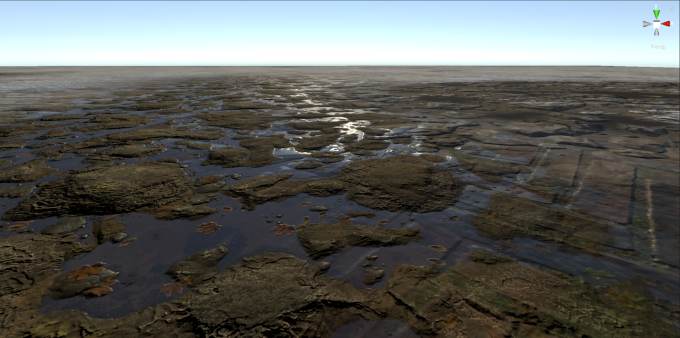
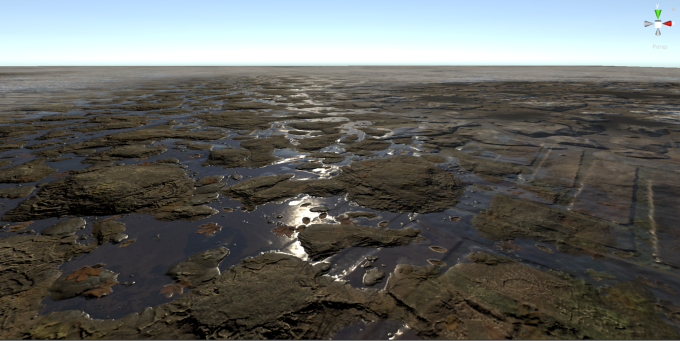
Blend terrain accurately in the Deferred and Deferred+ rendering paths in URP
When blending terrain in the Forward rendering path, Unity uses multi-pass rendering to calculate lighting for four layers at a time, and alpha-blends after each set of four layers. In the Deferred rendering paths, Unity combines terrain layers in the G-buffer pass using hardware blending, four layers at a time, then calculates lighting only once during the Deferred rendering pass. The approach in the Deferred rendering paths limits how correct the combination of property values is. For example, pixel normals cannot be accurately combined using the alpha blend equation alone, because one terrain layer might contain coarse terrain detail while another layer might contain fine detail. Averaging or summing normals results in a loss of accuracy.