High Definition Render Pipeline Glossary
General terms
atmospheric scattering
Atmospheric scattering is the phenomena that occurs when particles suspended in the atmosphere diffuse (or scatter) a portion of the light, passing through them, in all directions.
bokeh
The effect that occurs when a camera renders an out-of-focus point of light.
channel packing
A channel packed Texture is a Texture which has a separate grayscale image in each of its channels.
f-number
The ratio of the focal length to the diameter of the camera lens.
Nyquist rate:
The minimum rate at which you can sample a real-world signal without introducing errors. This is equal to double the highest frequency of the real-world signal.
physically-based rendering (PBR)
PBR is an approach to rendering that emulates accurate lighting of real-world materials.
ray marching:
An iterative ray intersection test where your ray marches back and forth until it finds the intersection or, in a more general case, solves the problem you define for it.
texture atlas:
A texture atlas is a large texture containing several smaller textures packed together. HDRP uses texture atlases for shadow maps and decals.
Normal mapping
tangent space normal map
A type of normal map in the UV space of the GameObject. You can use it on any Mesh, including deforming characters.
object space normal map
This contains the same details as the tangent space normal map, but also includes orientation data. You can only use this type of normal map on a static Mesh that does not deform. This normal map type is less resource-intensive to process, because Unity does not need to make any transform calculations.
world space normal map
HDRP uses the bent normal to prevent light leaking through the surface of a Mesh. In HDRP, bent normal maps can be in tangent space or object space.
Aliasing and anti-aliasing terms
aliasing:
Describes a distortion between a real-world signal and a digital reconstruction of a sample of a signal and the original signal itself.
fast approximate anti-aliasing (FXAA):
An anti-aliasing technique that smooths edges on a per-pixel level. It is not as resource intensive as other techniques.
spatial aliasing
Refers to aliasing in digital samples of visual signals.
temporal anti-aliasing (TAA):
An anti-aliasing technique that uses frames from a history buffer to smooth edges more effectively than fast approximate anti-aliasing. It is substantially better at smoothing edges in motion but requires motion vectors to do so.
Lighting terms
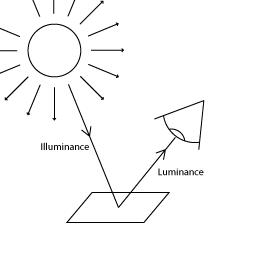
illuminance:
A measure of the amount of light (luminous flux) falling onto a given area. Differs from luminance because illuminance is a specific measurement of light whereas luminance describes visual perceptions of light.
luminous flux:
A measure of the total amount of visible light a light source emits.

luminous intensity:
A measure of visible light as perceived by human eyes. It describes the brightness of a beam of light in a specific direction. The human eye has different sensitivities to light of different wavelengths, so luminous intensity weights each different wavelength contribution by the standard luminosity function.

luminosity function:
A function that describes a wave that represents the human eye’s relative sensitivity to light of different wavelengths. This wave corresponds weight values, between 0 and 1 on the vertical axis, to different wavelengths, on the horizontal axis. For example, the standard luminosity function peaks, with a weight of 1, at a wavelength of 555 nanometers and decreases symmetrically with distance from this value.
punctual lights:
A light is considered to be punctual if it emits light from a single point. HDRPs Spot and Point Lights are punctual.