Custom NetworkVariables
In addition to the standard NetworkVariables available in Netcode for GameObjects, you can also create custom NetworkVariables for advanced implementations. The NetworkVariable and NetworkList classes were created as NetworkVariableBase class implementation examples. While the NetworkVariable<T> class is considered production ready, you might run into scenarios where you have a more advanced implementation in mind. In this case, you can create your own custom implementation.
Note
Read the Serialization overview page to understand how Netcode for GameObjects handles serialization.
To create your own NetworkVariableBase-derived container, you should:
- Create a class deriving from
NetworkVariableBase. - Override the following methods:
void WriteField(FastBufferWriter writer)void ReadField(FastBufferReader reader)void WriteDelta(FastBufferWriter writer)void ReadDelta(FastBufferReader reader, bool keepDirtyDelta)
- Depending on your custom
NetworkVariableBasecontainer, you can look atNetworkVariable<T>orNetworkListto see how those two examples were implemented.
NetworkVariable serialization
The way you read and write NetworkVariables changes depending on the type you use.
- Known, non-generic types can use
FastBufferWriterandFastBufferReaderto serialize theNetworkVariablevalue. - Integer types: This type gives you the option to use
BytePackerandByteUnpackerto compress theNetworkVariablevalue. This process can save bandwidth but adds CPU processing time. - Generic types: Use serializers that Unity generates based on types discovered during a compile-time code generation process. This means you need to tell Unity's code generation algorithm which types to generate serializers for. To tell Unity which types to serialize, use the following methods:
- Use
GenerateSerializationForTypeAttributeto serialize hard-coded types. - Use
GenerateSerializationForGenericParameterAttributeto serialize generic types.
- Use
- Types implementing
INetworkSerializablecan also be serialized usingFastBufferWriterandFastBufferReader.
Read more about custom serialization for more approaches to customizing serialization.
Serialize a hard-coded type
The following code example uses GenerateSerializationForTypeAttribute to generate serialization for a specific hard-coded type:
[GenerateSerializationForType(typeof(Foo))]
public class MyNetworkVariableTypeUsingFoo : NetworkVariableBase {}
You can call a type that you know the name of with the FastBufferReader or FastBufferWriter methods. These methods don't work for generic types because the name of the type is unknown.
Serialize a generic type
The following code example uses GenerateSerializationForGenericParameterAttribute to generate serialization for a specific generic parameter in your NetworkVariable type:
[GenerateSerializationForGenericParameter(0)]
public class MyNetworkVariableType<T> : NetworkVariableBase {}
This attribute accepts an integer that indicates which parameter in the type to generate serialization for. This value is 0-indexed, which means that the first type is 0, the second type is 1, and so on.
The following code example places the attribute more than once on one class to generate serialization for multiple types, in this case,TFirstType and `TSecondType:
[GenerateSerializationForGenericParameter(0)]
[GenerateSerializationForGenericParameter(1)]
public class MyNetworkVariableType<TFirstType, TSecondType> : NetworkVariableBase {}
The GenerateSerializationForGenericParameterAttribute and GenerateSerializationForTypeAttribute attributes make Unity's code generation create the following methods:
NetworkVariableSerialization<T>.Write(FastBufferWriter writer, ref T value);
NetworkVariableSerialization<T>.Read(FastBufferWriter writer, ref T value);
NetworkVariableSerialization<T>.Duplicate(in T value, ref T duplicatedValue);
NetworkVariableSerialization<T>.AreEqual(in T a, in T b);
For dynamically-allocated types with a value that isn't null (for example, managed types and collections like NativeArray and NativeList) call Read to read the value in the existing object and write data into it directly (in-place). This avoids more allocations.
You can use AreEqual to determine if a value is different from the value that Duplicate cached. This avoids sending the same value multiple times. You can also use the previous value that Duplicate cached to calculate deltas to use in ReadDelta and WriteDelta.
The type you use must be serializable according to the supported types list. Each type needs its own serializer instantiated, so this step tells the codegen which types to create serializers for. Unity's code generator assumes that all NetworkVariable types exist as fields inside NetworkBehaviour types. This means that Unity only inspects fields inside NetworkBehaviour types to identify the types to create serializers for.
Note
These attributes won't generate delta serialization. If you would like to customize how deltas are sent when a custom value has partially changed, refer to UserNetworkVariableSerialization.
Custom NetworkVariableBase example
This example shows a custom NetworkVariable type to help you understand how you might implement such a type. In the current version of Netcode for GameObjects, this example is possible without using a custom NetworkVariable type; however, for more complex situations that aren't natively supported, this basic example should help inform you of how to approach the implementation:
// Using MyCustomNetworkVariable within a NetworkBehaviour
internal class TestMyCustomNetworkVariable : NetworkBehaviour
{
    public MyCustomNetworkVariable CustomNetworkVariable = new MyCustomNetworkVariable();
    public MyCustomGenericNetworkVariable<int> CustomGenericNetworkVariable = new MyCustomGenericNetworkVariable<int>();

    public override void OnNetworkSpawn()
    {
        if (IsServer)
        {
            for (int i = 0; i < 4; i++)
            {
                var someData = new SomeData
                {
                    SomeFloatData = i,
                    SomeIntData = i
                };
                someData.SomeListOfValues.Add((ulong)i + 1000000);
                someData.SomeListOfValues.Add((ulong)i + 2000000);
                someData.SomeListOfValues.Add((ulong)i + 3000000);
                CustomNetworkVariable.SomeDataToSynchronize.Add(someData);
                CustomNetworkVariable.SetDirty(true);

                CustomGenericNetworkVariable.SomeDataToSynchronize.Add(i);
                CustomGenericNetworkVariable.SetDirty(true);
            }
        }
    }
}

/// <summary>
/// Bare minimum example of NetworkVariableBase derived class
/// </summary>
[Serializable]
public class MyCustomNetworkVariable : NetworkVariableBase
{
    /// <summary>
    /// Managed list of class instances
    /// </summary>
    internal List<SomeData> SomeDataToSynchronize = new List<SomeData>();

    /// <summary>
    /// Writes the complete state of the variable to the writer
    /// </summary>
    /// <param name="writer">The stream to write the state to</param>
    public override void WriteField(FastBufferWriter writer)
    {
        // Serialize the data we need to synchronize
        writer.WriteValueSafe(SomeDataToSynchronize.Count);
        foreach (var dataEntry in SomeDataToSynchronize)
        {
            writer.WriteValueSafe(dataEntry.SomeIntData);
            writer.WriteValueSafe(dataEntry.SomeFloatData);
            writer.WriteValueSafe(dataEntry.SomeListOfValues.Count);
            foreach (var valueItem in dataEntry.SomeListOfValues)
            {
                writer.WriteValueSafe(valueItem);
            }
        }
    }

    /// <summary>
    /// Reads the complete state from the reader and applies it
    /// </summary>
    /// <param name="reader">The stream to read the state from</param>
    public override void ReadField(FastBufferReader reader)
    {
        // De-Serialize the data being synchronized
        var itemsToUpdate = 0;
        reader.ReadValueSafe(out itemsToUpdate);
        SomeDataToSynchronize.Clear();
        for (int i = 0; i < itemsToUpdate; i++)
        {
            var newEntry = new SomeData();
            reader.ReadValueSafe(out newEntry.SomeIntData);
            reader.ReadValueSafe(out newEntry.SomeFloatData);
            var itemsCount = 0;
            var tempValue = (ulong)0;
            reader.ReadValueSafe(out itemsCount);
            newEntry.SomeListOfValues.Clear();
            for (int j = 0; j < itemsCount; j++)
            {
                reader.ReadValueSafe(out tempValue);
                newEntry.SomeListOfValues.Add(tempValue);
            }

            SomeDataToSynchronize.Add(newEntry);
        }
    }

    /// <summary>
    /// Used to write partial updates rather than synchronizing the full state on every change.
    /// </summary>
    /// <param name="writer">The stream to write the state to</param>
    public override void WriteDelta(FastBufferWriter writer)
    {
        // Not implemented for this example, instead we can write the field
        WriteField(writer);
    }

    /// <summary>
    /// Used to read partial updates rather than synchronizing the full state on every change.
    /// </summary>
    /// <inheritdoc/>
    public override void ReadDelta(FastBufferReader reader, bool keepDirtyDelta)
    {
        // Not implemented for this example, instead we can read the field
        ReadField(reader);
    }

}

/// <summary>
/// Bare minimum example of generic NetworkVariableBase derived class
/// </summary>
/// <typeparam name="T">Generic type marker</typeparam>
[Serializable]
[GenerateSerializationForGenericParameter(0)]
public class MyCustomGenericNetworkVariable<T> : NetworkVariableBase
{
    /// <summary>Managed list of class instances</summary>
    public List<T> SomeDataToSynchronize = new List<T>();

    /// <summary>
    /// Writes the complete state of the variable to the writer
    /// </summary>
    /// <param name="writer">The stream to write the state to</param>
    public override void WriteField(FastBufferWriter writer)
    {
        // Serialize the data we need to synchronize
        writer.WriteValueSafe(SomeDataToSynchronize.Count);
        for (var i = 0; i < SomeDataToSynchronize.Count; ++i)
        {
            var dataEntry = SomeDataToSynchronize[i];
            // NetworkVariableSerialization<T> is used for serializing generic types
            NetworkVariableSerialization<T>.Write(writer, ref dataEntry);
        }
    }

    /// <summary>
    /// Reads the complete state from the reader and applies it
    /// </summary>
    /// <param name="reader">The stream to read the state from</param>
    public override void ReadField(FastBufferReader reader)
    {
        // De-Serialize the data being synchronized
        var itemsToUpdate = 0;
        reader.ReadValueSafe(out itemsToUpdate);
        SomeDataToSynchronize.Clear();
        for (int i = 0; i < itemsToUpdate; i++)
        {
            T newEntry = default;
            // NetworkVariableSerialization<T> is used for serializing generic types
            NetworkVariableSerialization<T>.Read(reader, ref newEntry);
            SomeDataToSynchronize.Add(newEntry);
        }
    }

    /// <summary>
    /// Used to write partial updates rather than synchronizing the full state on every change.
    /// </summary>
    /// <param name="writer">The stream to write the state to</param>
    public override void WriteDelta(FastBufferWriter writer)
    {
        // Not implemented for this example, instead we can write the field
        WriteField(writer);
    }

    /// <summary>
    /// Used to read partial updates rather than synchronizing the full state on every change.
    /// </summary>
    /// <inheritdoc/>
    public override void ReadDelta(FastBufferReader reader, bool keepDirtyDelta)
    {
        // Not implemented for this example, instead we can read the field
        ReadField(reader);
    }
}

[Serializable]
internal class SomeData
{
    public int SomeIntData = default;
    public float SomeFloatData = default;
    public List<ulong> SomeListOfValues = new List<ulong>();
}
While the above example isn't the recommended way to synchronize a list where the number or order of elements in the list often changes, it's an example of how you can define your own rules using NetworkVariableBase.
You can test the code above by:
- Using the above code with a project that includes Netcode for GameObjects.
- Adding the
TestMyCustomNetworkVariablecomponent to an in-scene placed NetworkObject. - Creating a stand alone build and running that as a host or server.
- Running the same scene within the Editor and connecting as a client.
- Once connected, you can then select the GameObject with the attached NetworkObject and
TestMyCustomNetworkVariablecomponents so it appears in the inspector view. There you can verify theTestMyCustomNetworkVariable.CustomNetworkVariableproperty was synchronized with the client (like in the screenshot below):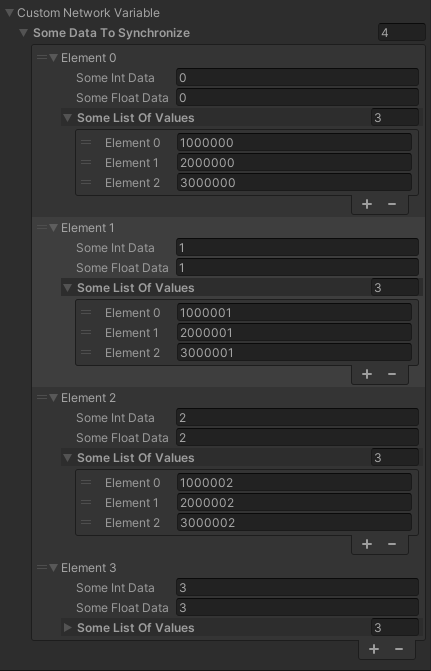
- Once connected, you can then select the GameObject with the attached NetworkObject and
Note
You can't nest NetworkVariables inside other NetworkVariable classes. This is because Netcode for GameObjects performs a code generation step to define serialization callbacks for each type it finds in a NetworkVariable. The code generation step looks for variables as fields of NetworkBehaviour types; it misses any NetworkVariables declared anywhere else.
Instead of nesting NetworkVariables inside other NetworkVariable classes, declare NetworkVariable or NetworkList properties within the same NetworkBehaviour within which you have declared your custom NetworkVariableBase implementation.