Use case: Load a scene from the cloud
This use case outlines the basics of setting up a streaming-ready scene. Use this use case to learn how to stream a scene from the cloud.
Prerequisites
To accomplish this use case, you require the following:
- Install the Data Streaming package on a new or existing Unity project (refer to Installation).
- Add these packages to the
manifest.json:
  {
    "dependencies": {
      // Add these lines:
      // Replace "<x.y.z>" with the version you wish to install
      "com.unity.cloud.identity": "<x.y.z>",
      "com.unity.cloud.storage": "<x.y.z>"
      // Other dependencies...
    }
  }
Overview
To accomplish this use case, do the following:
- Upload a scene
- Create a cloud streaming behavior
- Set up a new scene
Upload a scene
To upload a scene, follow these steps:
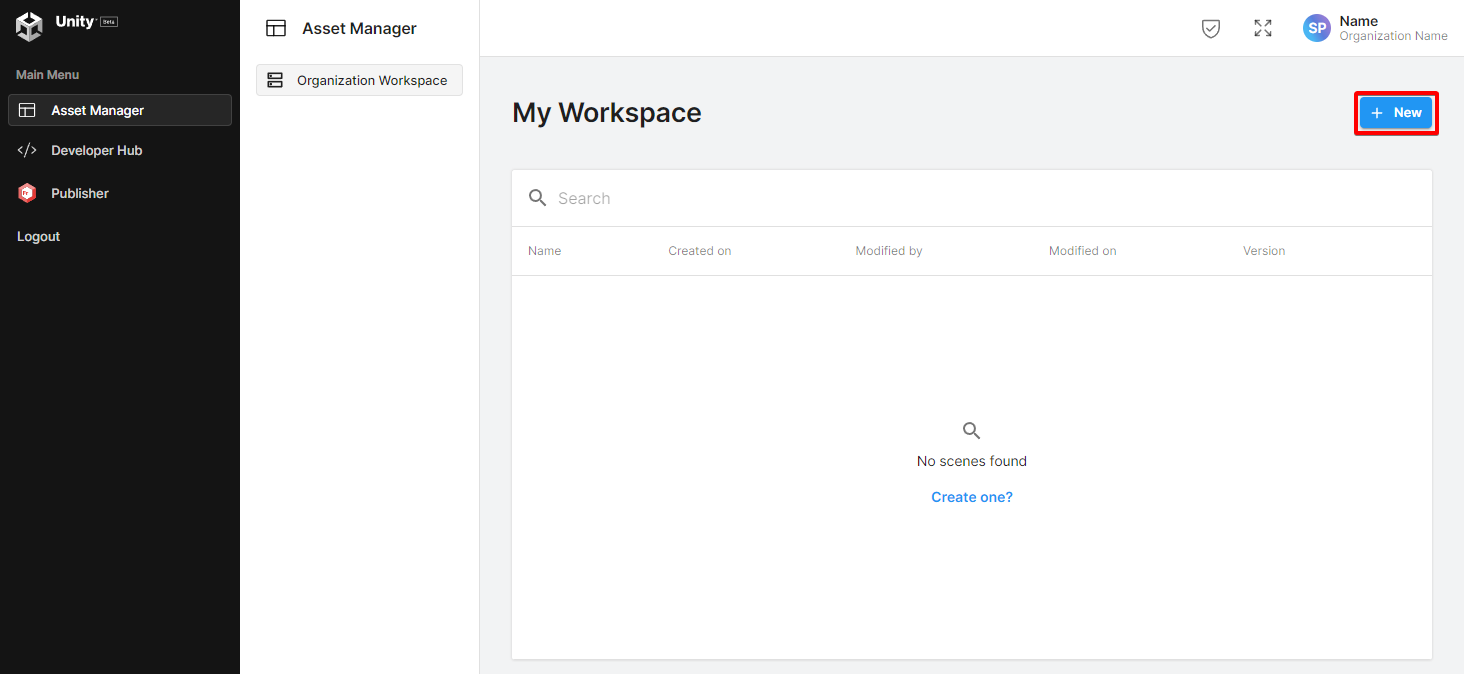
- Log into the Digital Twin Dashboard.
Select New to create a scene.
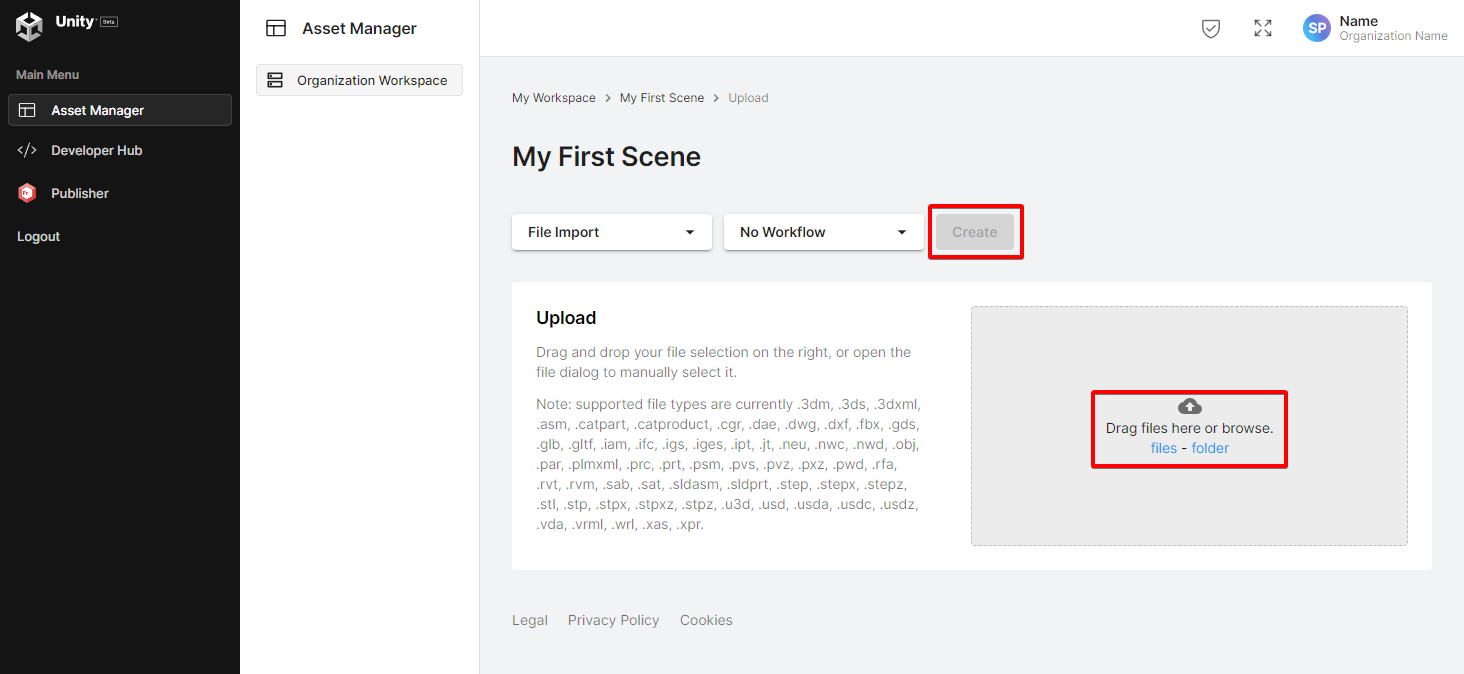
Name the scene
My First Sceneand select Create.Select files to upload a file.
Create a cloud streaming behavior
To create a cloud streaming behavior, follow these steps:
- Open your Unity project.
- Go to the Assets folder in the Project window.
- Right Click and Select Create > C# Script.
- Rename the new script as
CloudDataStreaming. - Open the
CloudDataStreamingscript and replace the content with the following:using System; using System.Threading.Tasks; using Unity.Cloud.Common; using Unity.Cloud.Common.Runtime; using Unity.Cloud.DataStreaming.Runtime; using Unity.Cloud.Identity; using Unity.Cloud.Identity.Runtime; using Unity.Cloud.Storage; using UnityEngine; public class CloudDataStreaming : MonoBehaviour { [SerializeField] string m_SceneId; [SerializeField] Camera m_Camera; [SerializeField] float m_ScreenSpaceError = SceneObserverFactory.DefaultScreenSpaceError; IServiceHostResolver m_ServiceHostResolver; UnityHttpClient m_HttpClient; CompositeAuthenticator m_Authenticator; ServiceHttpClient m_Service; DataStreamer m_Streamer; async Task Start() { try { m_ServiceHostResolver = UnityRuntimeServiceHostResolverFactory.Create(); m_HttpClient = new UnityHttpClient(); // Authenticate var authenticationPlatformSupport = PlatformSupportFactory.GetAuthenticationPlatformSupport(); var playerSettings = UnityCloudPlayerSettings.Instance; var pkceAuthenticatorSettingsBuilder = new PkceAuthenticatorSettingsBuilder(authenticationPlatformSupport, m_ServiceHostResolver); pkceAuthenticatorSettingsBuilder.AddDefaultConfigurationProviderAndRequestHandler(m_HttpClient, playerSettings) .AddDefaultAccessTokenExchanger(m_HttpClient); var compositeAuthenticatorSettings = new CompositeAuthenticatorSettingsBuilder(m_HttpClient, authenticationPlatformSupport, m_ServiceHostResolver) .AddDefaultPersonalAccessTokenProvider() .AddAuthenticator(new CommandLineAccessTokenProvider(pkceAuthenticatorSettingsBuilder.Build())) .AddDefaultPkceAuthenticator(playerSettings) .Build(); m_Authenticator = new CompositeAuthenticator(compositeAuthenticatorSettings); await m_Authenticator.InitializeAsync(); if (m_Authenticator.AuthenticationState == AuthenticationState.LoggedOut) await m_Authenticator.LoginAsync(); m_Service = new ServiceHttpClient(m_HttpClient, m_Authenticator, playerSettings); // Retrieving our uploaded scene. var sceneProvider = new SceneProvider(m_Service, m_ServiceHostResolver); var scene = await sceneProvider.GetSceneAsync(new SceneId(m_SceneId)); // Create the settings for our streamer. var builder = DataStreamerSettingsBuilder.CreateDefaultBuilder(); builder.SetScene(scene, m_Service, m_ServiceHostResolver); var settings = builder.Build(); // Start to stream. m_Streamer = new DataStreamer(); var observer = SceneObserverFactory.CreateCameraObserver(m_Camera, m_ScreenSpaceError); m_Streamer.AddObserver(observer); m_Streamer.Open(settings); } catch (Exception exception) { Debug.LogException(exception); } } void OnDestroy() { m_Streamer?.Close(); m_Authenticator?.Dispose(); } }
Set up a new scene
To set up a new scene, follow these steps:
- Create a new scene.
- Create a GameObject called Streamer.
- Select Add Component in the Inspector window and add the Cloud Data Streaming component.
- Copy the scene id part of the scene details on the Digital Twin Dashboard.
- Paste the Scene ID in the Cloud Data Streaming inspector field.
- Add a Camera in your scene if one doesn't exist.
- Set the CloudDataStreaming Component Camera value to your scene camera.
- Select Play to view your project load in front of the camera.1
1 If the scene does not load in front of the camera, select the menu item Edit / Frame Streamed Scene.